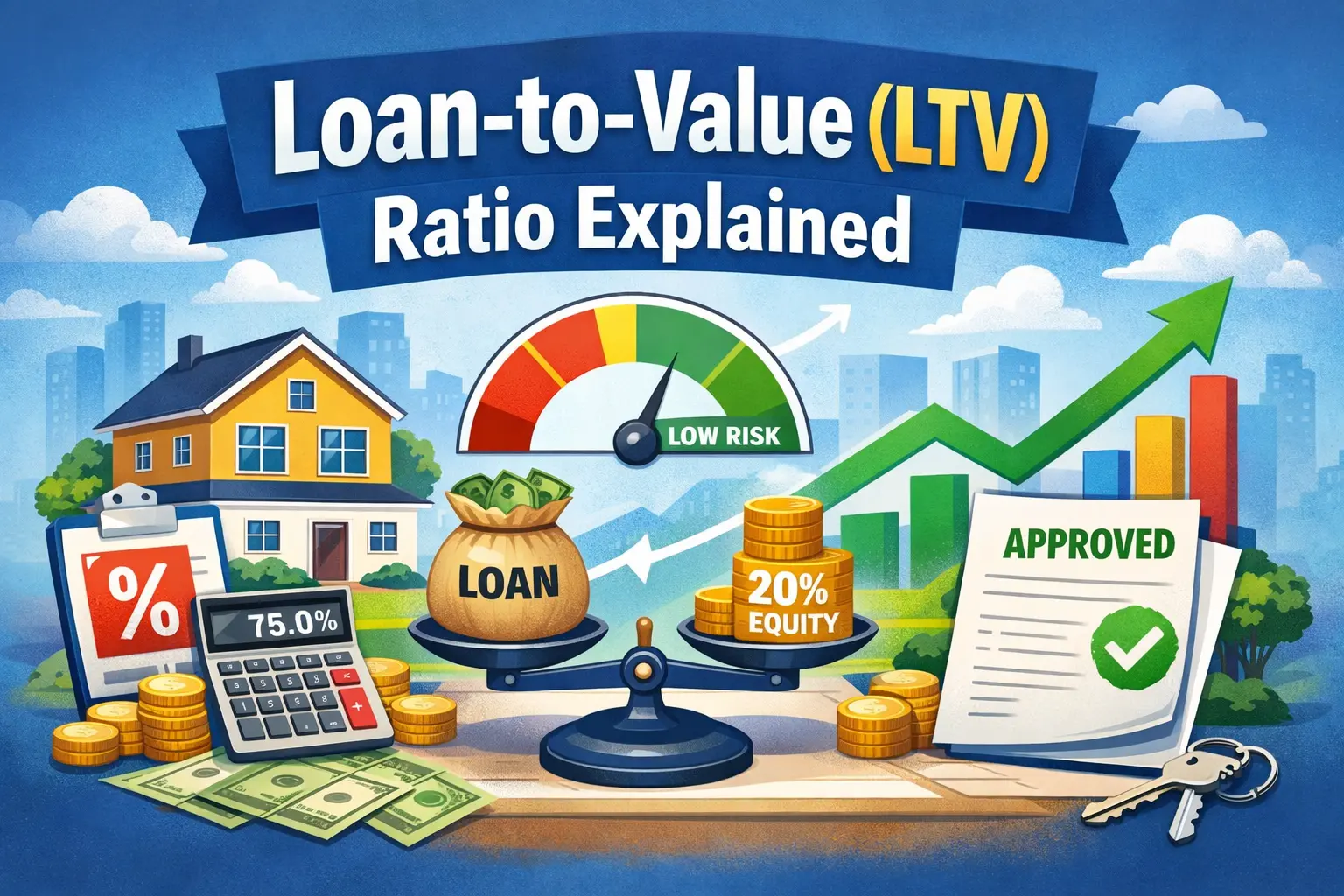
When applying for a mortgage, lenders focus on several key factors to assess risk—and one of the most important is the free loan-to-value (LTV) ratio. Understanding this ratio is crucial for anyone looking to buy a home, refinance, or use home equity to access funds. But what exactly is the LTV ratio, and why does it matter for borrowers and lenders alike?
In simple terms, the loan-to-value ratio explained is a percentage that shows how much of a property’s value is being borrowed. It directly affects mortgage approval, interest rates, and even the types of loans available to you.
Whether you are a first-time buyer or a seasoned homeowner, knowing your mortgage LTV ratio helps you make smarter financial decisions. Plus, with our LTV calculator, you can quickly determine your loan-to-value ratio in seconds, without complicated math.
In this guide, we will cover:
- What is LTV ratio and why it matters – Learn how lenders use the loan-to-value ratio to measure risk and decide mortgage eligibility. Knowing this upfront helps you understand how much of your property’s value you’re borrowing and how it impacts your mortgage options.
- How to calculate your LTV ratio – Understand the simple formula and steps to calculate LTV percentage for any home loan. This empowers you to make faster and more informed borrowing decisions.
- Real-life examples of LTV in action – See practical mortgage scenarios, including first-time buyers, low deposit situations, and remortgaging cases, so you can relate the numbers to your own situation.
- How LTV affects mortgage rates and approvals – Discover why higher LTV ratios often mean higher interest rates and fewer loan options, and how small changes in your deposit or property value can make a big difference.
- Tips to lower your LTV ratio for better deals – Explore practical strategies to improve your LTV and qualify for more competitive mortgage rates, helping you save money and reduce risk.
What Is Loan-to-Value (LTV) Ratio?
The free loan-to-value (LTV) ratio is a financial metric that represents the ratio of a mortgage loan to the value of the property being purchased. It is expressed as a percentage and is one of the first things lenders look at when assessing mortgage applications.
Definition:
LTV Ratio = (Loan Amount ÷ Property Value) × 100
From a lender’s perspective, the LTV ratio measures risk. The higher the LTV, the more the lender stands to lose if the borrower defaults. Conversely, a lower LTV ratio indicates a safer investment for the lender.
It’s important to distinguish between deposit and LTV:
- A 20% deposit usually corresponds to an 80% LTV.
- A smaller deposit, say 10%, results in a 90% LTV.
Understanding your LTV helps you evaluate your mortgage options and plan for long-term affordability.
LTV Ratio Formula & Why It Matters
The loan-to-value (LTV) ratio is a financial metric that shows the relationship between your mortgage loan and the value of the property. It is expressed as a percentage and calculated using this formula:
LTV Ratio (%) = (Loan Amount ÷ Property Value) × 100
Example:
If you are taking a loan of $180,000 on a property worth $240,000:
LTV = (180,000 ÷ 240,000) × 100 = 75%
This means 75% of the property’s value is financed through the mortgage, while the remaining 25% comes from your deposit.
Why This Matters:
Understanding the LTV ratio is crucial because it directly impacts how lenders perceive risk. A higher LTV indicates that a larger portion of the property is being financed, which can make lenders view the loan as riskier. This can affect:
- Mortgage approval chances – higher LTV may require stricter criteria.
- Interest rates – loans with higher LTV often carry higher rates.
- Loan options – certain types of mortgages or programs may only be available for lower LTV ratios.
By knowing your LTV ratio, you can make smarter decisions, such as increasing your deposit or selecting a loan type that suits your financial situation.
How to Calculate LTV (Step-by-Step Guide)
Calculating your loan-to-value ratio manually is simple. Follow these steps:
Step 1: Determine Property Value
Use either the purchase price or current market value of the property.
Step 2: Identify Loan Amount
This is the total mortgage you are planning to borrow.
Step 3: Apply the Formula
Divide the loan amount by the property value, then multiply by 100 to get the percentage.
Step 4: Interpret the Result
This is your LTV ratio, which helps you gauge lender risk and potential mortgage rates.
Tip: Instead of doing it manually, use our loan-to-value calculator for quick and accurate results.
Loan-to-Value Ratio Examples (Real Scenarios)
Here are some practical LTV ratio examples to illustrate how it works:
| Scenario | Property Value | Loan Amount | LTV Ratio | Risk Interpretation |
| First-Time Buyer | $200,000 | $160,000 | 80% | Standard risk, most lenders accept |
| Remortgage | $300,000 | $180,000 | 60% | Low risk, very favorable rates |
| Low Deposit Buyer | $250,000 | $225,000 | 90% | High risk, higher interest rates |
Explanation:
- 80% LTV – considered a common benchmark for most lenders; moderate risk.
- 60% LTV – low-risk, eligible for best mortgage rates.
- 90% LTV – high-risk; lenders may require additional checks or higher interest rates.
Including a risk interpretation column makes it easier for readers to quickly understand the implications of their LTV ratio, enhancing scan-ability and usability.
What Is a Good LTV for a Mortgage?
A good LTV for mortgage depends on your financial goals and lender requirements. In general:
- 60% LTV – Excellent rates, very low risk
- 75% LTV – Strong position, competitive mortgage options
- 80% LTV – Common benchmark for many loans
- 90%+ LTV – High risk, higher interest rates
Mortgage LTV requirements vary by lender and loan type, but the principle is consistent: lower LTV equals better rates and easier approval.
LTV and Mortgage Rates: How LTV Impacts Interest Rates
There is a direct correlation between your LTV ratio and the mortgage interest rate lenders offer. Generally:
| LTV Ratio | Expected Interest Rate | Risk Level |
| ≤ 60% | Very low | Low risk |
| 61–75% | Competitive | Moderate risk |
| 76–80% | Standard | Standard risk |
| 81–90% | Higher | High risk |
| 91%+ | Significantly higher | Very high risk |
Explanation:
- Lower LTV (≤60%) → Lenders see you as low risk, giving access to the best interest rates.
- Moderate LTV (61–80%) → Competitive rates available, but small deposit adjustments can improve offers.
- High LTV (81%+) → Higher interest rates, stricter approval, or extra checks.
Including a visual table helps readers quickly interpret how their LTV ratio affects potential interest rates, making the content more user-friendly and scannable.
High LTV vs Low LTV: Pros & Cons
| Type | Pros | Cons |
| High LTV Mortgage Meaning | Low deposit required | Higher interest, more risk |
| Low LTV Mortgage | Lower interest, safer | Requires larger deposit |
Lower LTV mortgages are generally more financially stable, while higher LTV mortgages allow buyers with smaller deposits to enter the market.
How to Lower Your LTV Ratio
Improving your LTV ratio can help you secure better mortgage rates, reduce risk, and qualify for more favorable loan options. Here’s a priority-based approach:
| Priority | Strategy | How It Helps |
| 1 | Increase Your Deposit | Directly lowers LTV; the larger the deposit, the lower the ratio and the risk perceived by lenders. |
| 2 | Make Mortgage Overpayments | Reduces your loan balance faster, decreasing LTV over time without changing property value. |
| 3 | Wait for Property Value to Rise | If the market value of your home increases, your LTV automatically improves. |
| 4 | Grow Home Equity | Using equity wisely or paying down other debts can improve your financial profile and lower effective LTV. |
Tip: Start with the strategies that are easiest and fastest to implement for your situation. For example, increasing your deposit upfront may have a bigger immediate impact than waiting for property appreciation.
Presenting strategies in a priority table makes it easy for readers to quickly identify the most effective actions first, enhancing UX and engagement.
LTV vs Home Equity: What’s the Difference?
While LTV and free home equity loan calculator are related, they measure different things:
| Metric | Formula | What It Represents | Example |
| Home Equity | Property Value − Loan Balance | Your ownership stake in the property | $240,000 − $180,000 = $60,000 |
| LTV Ratio | Loan Amount ÷ Property Value × 100 | The portion of the property financed by the loan | $180,000 ÷ $240,000 × 100 = 75% |
Explanation:
- Home Equity shows how much of the property you truly own.
- LTV Ratio shows how much is still financed by your mortgage.
- As you pay down your loan or if property value rises, home equity increases and LTV decreases.
Including a visual comparison table helps readers immediately see the relationship between LTV and equity, improving scannability and comprehension.
LTV Ratio for US Mortgages
In the United States, the LTV ratio works the same way but varies depending on loan type:
| Loan Type | Maximum LTV Allowed | Notes |
| FHA Loans | Up to 96.5% | Allows low down payments for first-time buyers |
| Conventional Loans | 80–95% | Typical LTV limits; lower LTV preferred for best rates |
| VA Loans | Up to 100% | Available for eligible veterans; no down payment required |
How LTV Changes Over Time:
Your LTV ratio is not fixed—it can improve naturally over time through:
- Repaying your mortgage: Every payment reduces your loan balance, lowering LTV.
Property value appreciation: If your home’s market value increases, your LTV decreases even without extra payments.
Example Timeline:
| Year | Property Value | Loan Balance | LTV Ratio |
| 2025 | $300,000 | $240,000 | 80% |
| 2026 | $310,000 | $230,000 | 74% |
| 2027 | $320,000 | $220,000 | 69% |
This timeline shows how a combination of regular mortgage payments and property appreciation can reduce your LTV ratio, improving your financial position and mortgage options.
Frequently Asked Questions (FAQs)
Q1: What is the maximum LTV allowed?
Maximum mortgage LTV requirements vary by lender and loan type. Conventional loans may allow 80–95%, FHA up to 96.5%, and VA loans up to 100%.
Q2: Can I get a mortgage with 95% LTV?
Yes, but this is considered a high LTV mortgage and may come with higher interest rates.
Q3: How do I check my loan-to-value?
You can manually calculate it using the formula or use an online tool to check loan-to-value instantly.
Q4: Is LTV the same as equity?
No, LTV vs equity are different. Equity represents your ownership stake in the property, while LTV measures the ratio of the loan to the property value.
Q5: How do I use the LTV calculator?
Using our LTV calculator is simple and fast. Just follow these steps:
- Enter the property value – This is either the purchase price of your home or its current market value.
- Enter the loan amount – This is the total mortgage you plan to borrow.
- Click calculate – The tool will instantly show your loan-to-value (LTV) ratio as a percentage.
- Interpret the result – A lower LTV generally indicates lower risk and may help you get better mortgage rates.
The calculator saves you from manual calculations and gives an accurate LTV percentage in seconds, helping you make informed mortgage decisions.
Q6: How can I lower my LTV using my service calculator?
Our LTV calculator lets you experiment with different scenarios to see how you can lower your LTV ratio. Here’s how:
- Adjust the deposit amount – Increasing your deposit reduces the loan needed, lowering your LTV.
- Change the loan amount – If possible, consider smaller loans or paying off part of the loan to improve your LTV.
- Simulate property value changes – Enter higher property values to see how appreciation affects your LTV.
By trying different inputs, you can plan strategies to reduce your LTV, qualify for better mortgage rates, and make smarter borrowing decisions before you finalize your loan.
Use Our Loan-to-Value (LTV) Calculator
Our LTV calculator makes it easy to calculate your loan-to-value ratio instantly. Simply enter your loan amount and property value, and get your LTV percentage in seconds. This tool is free, accurate, and helps you make informed mortgage decisions.
Conclusion
The loan-to-value (LTV) ratio is a critical metric in the mortgage process. Understanding your mortgage LTV ratio helps you plan better, secure favorable interest rates, and choose the right mortgage. By learning to calculate LTV percentage and improving your ratio over time, you can make smarter borrowing decisions and potentially save thousands on your mortgage.
Start by using our LTV calculator today and take control of your mortgage journey with confidence.